

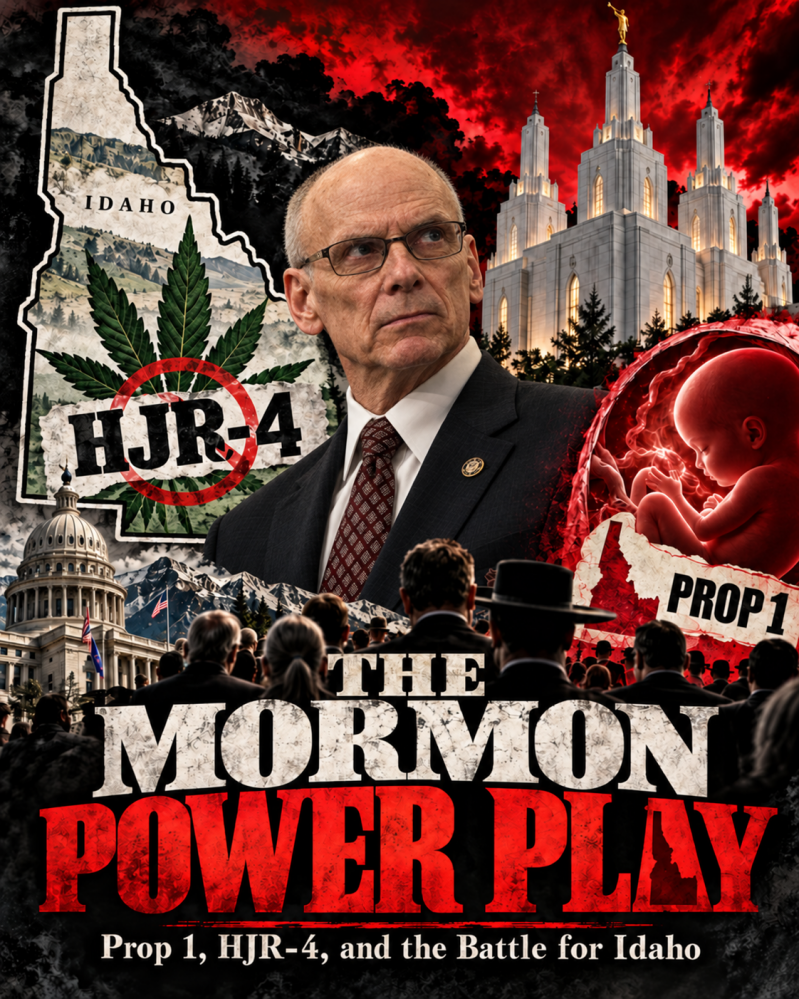
From California's Proposition 8 to Utah's medical marijuana battle and Idaho's HJR 4, the LDS Church has a documented history of entering political fights over the rights of ordinary citizens. Now, a former high-ranking Mormon leader sits at the center of Idaho's latest battle over the initiative process.
#ElChupacast | Political Commentary | October 11, 2026
The Church of Jesus Christ of Latter-day Saints, a Salt Lake City-based religion with an extensive financial and political presence throughout the American West, is once again flexing its political and financial muscle, making new inroads into Idaho with a significant direct contribution to the campaign against Proposition 1 and, in my opinion, raising serious questions about its possible connections to Idaho House Joint Resolution 4, or HJR 4.
Political involvement is hardly a recent phenomenon for the Church. Its founder and self-declared prophet, Joseph Smith, was running for president of the United States in 1844 before an armed mob stormed the jail in Carthage, Illinois, and killed him. Decades later, Ezra Taft Benson, a polarizing political figure with well-documented associations with the ultraconservative John Birch Society, served as President Dwight Eisenhower's secretary of agriculture before eventually becoming president of the LDS Church.
The extended Udall, Hunt, and Lee political family has produced numerous influential American public officials, as has the Romney family. Mitt Romney's father, George, sought the Republican presidential nomination, while Mitt's niece, Ronna McDaniel, eventually chaired the Republican National Committee.
Taken in historical context, it should surprise absolutely nobody that Mormonism and American politics have maintained a long and sometimes complicated relationship. The question isn't whether individual Mormons should be involved in politics. They have every right to participate. The question is what happens when an immensely wealthy religious institution begins using its organizational machinery and financial resources to shape the laws governing everyone else, including people who neither belong to the Church nor accept its religious authority.
CALIFORNIA'S PROPOSITION 8: WHEN THE CHURCH WENT TO WAR OVER MARRIAGE
In more recent decades, the LDS Church has committed significant organizational resources to battles over social and political issues. One of the clearest examples came in 2008, when California voters considered Proposition 8, a constitutional amendment designed to eliminate the right of same-sex couples to marry.
The LDS Church did considerably more than simply issue a theological objection.
According to its own financial disclosures, the Church reported $189,903.58 in institutional contributions supporting Proposition 8. These were in-kind contributions rather than direct campaign cash, covering expenses such as paid employee time, travel, and audiovisual production.
But that figure tells only part of the story.
- Individual Mormon donors were estimated to have contributed approximately $20 million to the campaign, a substantial share of the roughly $40 million raised by supporters. Because campaign-finance disclosures do not identify contributors by religion, that figure remains an estimate rather than an independently audited total. Nevertheless, the financial involvement attributed to LDS members was enormous, and it did not happen in an institutional vacuum.
- A letter from the Church's First Presidency, read to California congregations on June 29, 2008, called upon members to support the proposed constitutional amendment with their time and financial resources. Church officials also participated in organized campaign outreach, including telephone operations and broadcasts encouraging political participation.
- In October, senior Church leaders, including apostles M. Russell Ballard and Quentin L. Cook, addressed California members in a satellite broadcast about marriage doctrine and the campaign.
- Two years later, in June 2010, California's Fair Political Practices Commission approved a $5,539 fine against the LDS Church for failing to disclose approximately $37,000 in nonmonetary contributions within the required reporting period. The Church maintained that the reporting violation was unintentional.
The important point is not the size of the fine. It is the fact that the Church's involvement had moved well beyond religious instruction and into the practical machinery of a statewide political campaign. It had mobilized members, encouraged financial participation, devoted institutional resources, and helped advance a constitutional amendment affecting the civil rights of people who did not share its beliefs.
That became an important precedent for what followed.
IDAHO'S PROPOSITION 1: A MILLION DOLLARS TO MAKE YOUR FREEDOM PASS THROUGH THE PULPIT
Fast-forward to October 2026.
The Church of Jesus Christ of Latter-day Saints has just put one million dollars on the table to defeat Proposition 1 in Idaho.
According to Local News 8, the contribution represents the largest single donation to an Idaho campaign opposing Proposition 1. The money went to the political action committee Too Extreme for Idaho.
Apparently, recognizing doctors' ability to help patients with complicated pregnancies is considered too extreme, but spending a million dollars to prevent it fits comfortably within the budget of righteousness.
The contribution was publicly announced by Tom Luna, Idaho's former superintendent of public instruction and former chairman of the Idaho Republican Party, during an appearance on the Idaho Falls radio program NewsTalk 107. Local News 8 subsequently confirmed the donation and obtained an explanation from a Church spokesperson.
The Church insists that it remains politically neutral when it comes to candidates, but openly acknowledges intervening in ballot initiatives when it believes significant moral consequences are at stake.
That definition of political neutrality deserves a very close examination. Apparently, the Church can remain neutral about the names appearing on a ballot while spending a fortune influencing what rights the people casting those ballots should possess.
Proposition 1 would establish a constitutional right to reproductive freedom and privacy in Idaho. The proposal would protect medical providers who determine that fetal viability would threaten a mother's health and establish a legal framework governing that determination.
For the LDS Church, opposition to abortion is a religious and moral position. It certainly has the right to express that position. But when a religious institution spends a million dollars attempting to preserve a statewide prohibition, it is no longer simply instructing its membership about matters of faith. It is participating directly in a political campaign whose consequences extend to every Idaho resident, regardless of religious affiliation.
The Church has every right to defend its beliefs and participate in public debate. That right, however, does not exempt its political activities from public scrutiny, particularly when it attempts to influence laws governing the most intimate decisions citizens can make about their own lives.
And it raises a much larger question: How much power should any religious institution be permitted to exercise over the personal freedoms of citizens who never agreed to live under its doctrine? Whatever your stance is on this matter, it is a serious question.
UTAH'S PROPOSITION 2: WHEN THE VOTERS SPOKE, BUT THE LEGISLATURE GOT THE LAST WORD
To understand the possible significance of Idaho's HJR 4, we need to examine something that happened just across the state line in Utah.
Today, medical marijuana is legal in Utah. However, the path toward legalization was significantly shaped by the state's politically influential LDS Church.
In 2018, Utah voters considered Proposition 2, an initiative that would legalize medical cannabis. The Church publicly opposed the proposal, encouraged voters to reject it, and participated in negotiations to establish an alternative medical cannabis law.
This was not simply a handful of Mormon legislators acting independently according to their religious convictions. The institution itself was involved.
On October 4, 2018, the LDS Church officially announced its support for a negotiated compromise while continuing to oppose Proposition 2. Senior Church representatives participated in a coalition that included political leaders, medical organizations, and initiative supporters.
The voters nevertheless approved Proposition 2 in November. Then, on December 3, Utah lawmakers convened in a special legislative session and replaced the voter-approved initiative with the previously negotiated alternative, which was more restrictive in important respects, including limitations on home cultivation and cannabis dispensaries.
Now, there is an important distinction here. The Marijuana Policy Project, which supported Proposition 2, had also participated in the negotiations and acknowledged that the compromise legislation was intended to replace the initiative regardless of the election's outcome. In other words, supporters of legalization were part of the agreement. It would be inaccurate to suggest that the Church single-handedly overturned the initiative against the wishes of every organization supporting it.
But that does not erase the larger political reality.
The Church actively opposed the ballot initiative, participated in negotiations over its replacement, and supported a process under which the Legislature ultimately enacted a different law from the one voters approved. In my opinion, that reveals a distinct preference for a system in which the political establishment, including influential religious organizations, retains considerable control over the final outcome, even when citizens successfully exercise their initiative rights.
The people could vote, but the political and religious establishment would still have considerable influence over what the law ultimately became. The will of the voters, apparently, was something that could be negotiated after the election, with the Legislature deciding what was ultimately acceptable.
And that brings us to Idaho.
HJR 4: WHO GETS TO DECIDE WHETHER MARIJUANA IS LEGAL IN IDAHO?
Currently, Idaho has two basic avenues for legalizing and regulating marijuana, medical cannabis, and other substances. First, the Idaho Legislature can pass legislation authorizing their use and establishing the applicable regulations. Second, Idaho citizens can propose a law through the ballot initiative process, gather the required signatures, and put the issue directly before voters.
But House Joint Resolution 4 proposes to change those rules.
HJR 4 is a proposed amendment to the Idaho Constitution that would grant the Legislature exclusive authority to legalize marijuana, including medical marijuana, as well as narcotics and other psychoactive substances. If approved, Idaho citizens would lose their independent ability to legalize these substances through the initiative process.
A simple majority voting YES would amend the Constitution, placing legalization authority exclusively in the hands of state lawmakers. A NO vote would leave the Constitution unchanged and preserve the existing initiative route.
The Legislature approved HJR 4 in 2025, with the House voting 58–10 and the Senate approving it 29–6. The measure now goes before voters in the November 3, 2026, general election.
Its supporters argue that this would protect Idaho from well-funded commercial interests attempting to legalize drugs through expensive ballot campaigns, while opponents argue that it represents yet another attempt by lawmakers to weaken the initiative rights guaranteed to citizens under Idaho's Constitution.
And therein lies the issue.
This debate is not exclusively about marijuana. It is about who possesses the ultimate authority to make public policy: the citizens of Idaho, or the politicians who represent them?
C. SCOTT GROW: THE FORMER MORMON GENERAL AUTHORITY AT THE CENTER OF THE FIGHT
We have already established that the LDS Church intervened institutionally in Utah's medical marijuana debate and supported a legislative compromise that replaced a voter-approved initiative.
But what is the connection to Idaho?
That question brings us to one particularly interesting Republican lawmaker: Senator C. Scott Grow.
Grow's legislative record reveals a consistent progression, beginning with efforts to make citizen initiatives more difficult to qualify for the ballot and culminating in a constitutional amendment that would eliminate the initiative route for legalizing certain substances altogether.
The pattern begins shortly after Idaho voters approved Medicaid expansion in November 2018, with approximately 60.6 percent of the vote.
In 2019, Grow sponsored Senate Bill 1159, a proposal imposing substantially higher barriers on citizen initiatives. The legislation would have increased the required number of signatures from 6 percent to 10 percent of registered voters, expanded the geographic signature requirement from 18 to 32 of Idaho's 35 legislative districts, and reduced the time available to collect signatures from 18 months to just 180 days.
Those requirements would have prevented the successful 2018 Medicaid expansion initiative from qualifying under the proposed rules.
Grow defended the changes in part by arguing that rural voters deserved greater influence in the initiative process. Governor Brad Little vetoed the legislation, citing constitutional concerns.
But the effort to restrict citizen initiatives did not end there.
In 2021, Grow sponsored Senate Joint Resolution 101, a proposal to constitutionally prohibit further legalization of specified psychoactive substances, subject to exceptions. The Idaho Senate passed the measure 24–11, but it failed to advance through the House.
That same year, Grow supported another restrictive initiative bill, Senate Bill 1110, which required qualifying signatures from all 35 legislative districts. Although Senator Steve Vick was its principal sponsor, Grow supported the legislation. Governor Little signed it into law, but on August 23, 2021, the Idaho Supreme Court struck it down.
Once again, lawmakers had attempted to make the initiative process substantially more difficult, and once again, constitutional protections stood in the way.
In 2023, Grow voted in favor of SJR 101a, another proposed constitutional amendment requiring initiative and referendum petitions to gather signatures from every legislative district. The proposal passed the Senate 27–8 but failed to obtain the required two-thirds majority in the House, where the vote was 39–31.
Then came HJR 4 in 2025.
Grow joined Representative Bruce Skaug in sponsoring the proposed amendment, which would grant the Legislature exclusive authority over legalization of marijuana and other covered substances. Unlike the previous attempts to impose broad signature requirements, HJR 4 takes a more targeted approach. Rather than making initiatives harder to qualify generally, it would remove one entire subject from the reach of citizen-initiated legalization legislation.
And the public remarks Grow has made in defense of the amendment help explain his thinking.
In March 2025, he warned about legislatures becoming overwhelmed by repeated legalization initiatives. By October 2026, Grow was arguing that HJR 4 would not give the Legislature additional power because legislators already possess the authority to legalize drugs.
Technically, that part is true. But it avoids the central constitutional question, because the amendment is not principally about giving legislators a power they lack. It is about taking away a power citizens currently possess.
Grow also argues that the public can participate in the legislative process through committee hearings and public testimony. Of course they can, but attending a legislative hearing and asking politicians to support a law is not the same thing as possessing the constitutional authority to propose and enact that law through a popular vote. One is a request made to those who already possess power; the other is a direct exercise of political power by the people themselves.
And Senator Grow has repeatedly supported measures that would make the latter more difficult or, in the case of HJR 4, unavailable for a particular subject.
That legislative record deserves scrutiny regardless of his religious background.
A CONSTITUTIONAL WARNING: DAVID ADLER WEIGHS IN
Dr. David Adler, a respected Idaho constitutional scholar and president of the Alturas Institute, has warned that HJR 4 carries consequences considerably broader than the legalization of marijuana. Adler argues that many voters misunderstand the constitutional implications of the proposal because they focus on the drug issue rather than the authority they would surrender.
His central concern is that Idaho citizens would voluntarily relinquish a significant part of their power to shape state law directly, potentially without fully appreciating what they are giving away.
Adler's warning deserves attention because the initiative process has long served as an alternative when elected officials refuse to address issues that have substantial public support. Idaho voters have used that process to advance measures involving government transparency, environmental protection, public administration, and healthcare. The fundamental point is that the initiative process belongs to the people, rather than being a privilege generously granted by legislators whenever they happen to approve of a particular policy proposal.
When lawmakers seek to remove specific issues from that process, citizens have every reason to ask why, particularly when the same lawmakers have repeatedly attempted to restrict initiative access through other legislative measures.
THE GROW CONNECTION: A PERSONAL HISTORY WITH THE LDS CHURCH
So what exactly is the relationship between C. Scott Grow and the LDS Church, and why do I find it significant?
Before going any further, I should make a personal disclosure. I am an apostate from the Mormon Church. I formally removed my membership records in 2010 after discovering significant disagreements with the Church's theology and receiving what I considered less-than-satisfactory answers concerning the historicity of several foundational events and claims.
That experience informs my perspective, but it does not eliminate the need for evidence.
I have never met C. Scott Grow in person. However, when I was serving in an LDS mission office in Rosario, Argentina, in 1989, I was asked to make a couple of telephone calls to his office while he was serving as mission president in Uruguay. Our interactions were brief, and my impression at the time was that he seemed like a nice guy.
Before completing my mission, I was transferred to Buenos Aires North, where I attended a ward with H. Verlan Andersen, an LDS General Authority serving as a counselor in the area's presidency. Andersen was an outspoken right-wing author associated with the political ideology promoted by Ezra Taft Benson and the John Birch Society. At that time, I had also been influenced by those political ideas, a period of my life whose ideological foolishness I have long since disavowed.
I had at least three lengthy conversations with Andersen about politics, and if my memory serves me correctly, he remarked on one occasion that Grow was one of the "good guys." That is my personal recollection of a conversation nearly four decades ago, not documentary proof of any present-day political arrangement. Nevertheless, it illustrates how long Grow has moved within influential LDS leadership circles, and that history is important.
FROM MISSION PRESIDENT TO GENERAL AUTHORITY TO IDAHO SENATOR
Grow served as president of the Uruguay Montevideo Mission from 1988 to 1991. In August 1995, he was called as an Area Authority, and in April 1997, he became a member of the Fifth Quorum of the Seventy. During his subsequent Church service, he held leadership responsibilities that included serving as president of the Idaho Area.
On April 2, 2005, he was sustained as a General Authority Seventy, a significantly higher institutional leadership position than an Area Seventy. His assignments over the years included senior Church responsibilities in Mexico, South America, Idaho, and other administrative areas.
Then came October 6, 2018.
On that date, the LDS Church announced that Grow had been released from active service as a General Authority Seventy and granted emeritus status.
Pay very close attention to that date.
Grow had already entered the Idaho Senate on August 15, 2018, when Governor Butch Otter appointed him to fill the vacancy left by Marv Hagedorn. Then, on November 6, 2018, Grow won election to the Idaho Senate from District 14, defeating Democrat Richard Boozel with approximately 69.6 percent of the vote.
In other words, Grow became an Idaho state senator while he was still an active LDS General Authority Seventy. His release from active ecclesiastical service came nearly two months after he entered public office and one month before he won election.
And although Grow was released from active leadership duties, the Church granted him emeritus status. That distinction matters because, while he was no longer serving in an active General Authority assignment, his emeritus designation recognized decades of senior Church leadership and a relationship with the institution that had occupied a substantial part of his adult life.
There is nothing inherently improper about a former religious leader entering politics. Nor does holding emeritus status establish that he is acting under instructions from Church headquarters. But it certainly makes his institutional history relevant when examining the political networks, relationships, and policy priorities he may have carried into elected office.
His transition from Church leadership to elected political office was not separated by years of retirement or institutional distance. In fact, for nearly two months, the two roles overlapped.
FOLLOW THE MONEY: WHAT WAS GROW PAID?
There is also a financial aspect of Grow's Church service that deserves examination.
While I don't have the receipts establishing precisely how much C. Scott Grow received in compensation, reimbursements, or living allowances during his years of Church service, I can tell you what I personally witnessed.
While working in an LDS mission office in Argentina in the late 1980s, I saw payments arriving from Salt Lake City for my own mission president. Based on my recollection, those payments amounted to more than $50,000 annually, and I know this because I saw the checks coming into the office. That was a substantial amount of money in the late 1980s, equivalent to well over $140,000 in today's purchasing power.
Now, I cannot establish that Grow received precisely the same amount, nor can I determine exactly how his compensation may have been structured. Nevertheless, considering that Grow served as mission president in Uruguay from 1988 to 1991 and subsequently occupied a series of increasingly senior ecclesiastical positions from 1995 until his release in 2018, I believe it is entirely reasonable to conclude that he likely continued receiving financial support or compensation from the Church during at least some of those subsequent 26 years.
What is significant is that Grow spent decades operating within the highest levels of the LDS Church's administrative and ecclesiastical structure, developing relationships with senior leaders and participating in an organization whose political interests have repeatedly extended beyond the boundaries of religious instruction. Those relationships did not simply evaporate when he accepted an appointment to the Idaho Senate in August 2018, particularly since he was still an active General Authority Seventy at the time and would not receive emeritus status until October 6 of that year.
His transition from Church leadership to elected political office occurred within a matter of weeks, and I find that timing particularly interesting given what subsequently happened in the Idaho Legislature.
THE IDAHO QUESTION: COINCIDENCE, CONVICTION, OR COORDINATION?
Now consider the pattern.
In California, the LDS Church mobilized members and institutional resources to support a constitutional amendment restricting same-sex marriage. In Utah, it formally opposed a medical marijuana initiative and participated in negotiating the legislation that subsequently replaced the voter-approved measure. In Idaho, it has now contributed one million dollars to defeat a citizens initiative. And in that same state, a former LDS General Authority Seventy, whose decades of senior Church service overlapped with the beginning of his legislative career, has spent years advancing legislation designed to restrict citizen initiatives, culminating in HJR 4.
The ideological parallels are difficult to ignore, particularly when examining what happened in Utah in 2018 and what Senator Grow is attempting to accomplish in Idaho. In both cases, the central institutional question is whether legalization should be decided through direct citizen action or controlled through the Legislature. The LDS Church openly supported the legislative compromise in Utah, while Grow now argues for legislative exclusivity in Idaho.
Does that prove that LDS headquarters instructed Grow to sponsor HJR 4, or establish that Church leaders designed the amendment and are secretly directing its campaign? No, and I have not uncovered a paper trail showing orders, coordination, campaign payments, or specific directives from current LDS General Authorities to Senator Grow regarding HJR 4. I am not going to pretend that such documentation exists merely because I believe the connection deserves investigation.
But the absence of direct documentary proof does not make the underlying questions unreasonable.
Given Grow's decades of service within the LDS hierarchy, his continuing emeritus status, the Church's documented involvement in comparable initiative battles, and his consistent legislative opposition to aspects of direct democracy, I believe there are legitimate grounds for asking whether there has been communication or political coordination. Frankly, I find it difficult to imagine that a man who spent so much of his adult life in senior leadership positions within an organization as centrally administered as the LDS Church would suddenly have no meaningful relationships with its leadership after entering public office, particularly when his legislative priorities so closely resemble positions the institution has previously defended.
That is my assessment, not proof of communication about HJR 4, but circumstantial evidence has a legitimate place in asking investigative questions, especially when the individuals, institutions, political objectives, and historical precedents overlap in ways that warrant closer examination.
The Church has already demonstrated, publicly and repeatedly, that it is willing to intervene in ballot initiatives when its leaders believe moral questions are involved. Its involvement in Utah's marijuana debate is not speculation, its million-dollar contribution in Idaho is not speculation, and Grow's record of attempting to restrict citizen initiatives is not speculation. What remains unanswered is whether those parallel interests have resulted in direct consultation, communication, or coordination concerning HJR 4.
THE REAL QUESTION ISN'T MARIJUANA. IT'S WHO OWNS IDAHO'S DEMOCRACY.
This is where all these seemingly separate controversies converge. California's Proposition 8 concerned marriage rights, Utah's Proposition 2 concerned medical cannabis, Idaho's Proposition 1 concerns reproductive rights and protection of doctors, and Idaho's HJR 4 concerns the constitutional authority of citizens to legalize certain substances without securing the Legislature's permission. Different subjects, certainly, but they share a common political theme: the struggle over who gets to determine the boundaries of personal freedom, and how much power ordinary citizens should retain when their preferences conflict with those of politically influential institutions.
There is nothing unconstitutional about churches expressing their beliefs, encouraging their members to vote, or participating in political advocacy within the law. Religious freedom protects those activities, just as it protects the rights of individual Mormons to serve in public office and advocate for policies consistent with their personal convictions. But religious freedom also includes the freedom of citizens to reject religious doctrine as the basis for their own personal choices, and a political system should not confuse the right of a Church to advocate for its beliefs with any automatic entitlement to impose those beliefs through the machinery of state government.
Before heading to the polls, I encourage everyone to look at Grow's legislative record since entering the Senate in 2018. His early efforts focused on raising the signature requirements and geographic barriers for qualifying initiatives, measures that would have made it substantially more difficult for ordinary citizens to place questions before voters. When those efforts encountered gubernatorial vetoes, judicial rejection, or insufficient legislative support, the broader effort to limit direct democracy continued. HJR 4 represents a narrower but potentially more consequential approach, because rather than merely making initiatives more difficult, it would eliminate the citizen initiative route to legalization altogether for the substances covered by the amendment.
And when the public is asked to surrender an existing political power, citizens deserve to know exactly why, whose interests are being served, and whether powerful institutions outside elected government have helped shape the proposal.
It is also the reason why HJR 4 deserves to be examined as something much more consequential than another political argument about marijuana. If Idaho voters approve this amendment, they will not simply be expressing opposition to drug legalization. They will be relinquishing their independent constitutional authority to pursue legalization through the initiative process and transferring that decision exclusively to the politicians sitting in Boise.
For a state that takes such enormous pride in individual liberty, limited government, and distrust of concentrated political authority, that should present a rather uncomfortable contradiction. Idahoans who believe in the right of the people to govern themselves ought to think carefully before voting to give their elected representatives a monopoly over decisions that the Constitution currently permits citizens to make directly!
Idaho voters should be asking those questions before they give up a constitutional power they may never get back. And no matter what anyone thinks about marijuana or reproductive rights, that is one political decision that deserves to be made with eyes wide open.
#ElChupacast
REFERENCES AND DOCUMENTATION
1. LDS Church's $1 million contribution against Idaho Proposition 1
Local News 8, October 10, 2026.
https://localnews8.com/news/2026/10/10/lds-church-million-dollar-prop-1-donation/
Deseret News, October 9, 2026.
2. California Proposition 8 and LDS institutional involvement
LDS Church statement concerning the California Fair Political Practices Commission settlement, June 8, 2010.
https://newsroom.churchofjesuschrist.org/article/statement-regarding-fppc-settlement
LDS Church statement on the judicial ruling against Proposition 8, August 4, 2010.
https://newsroom.churchofjesuschrist.org/article/church-statement-on-proposition-8-ruling
3. Utah Proposition 2 and the LDS Church's negotiated medical marijuana compromise
Official LDS Church announcement, October 4, 2018.
https://newsroom.churchofjesuschrist.org/article/compromise-medical-cannabis-utah
Marijuana Policy Project, agreement involving lawmakers and LDS Church representatives.
Deseret News, comparison of Proposition 2 and the negotiated replacement legislation.
4. Idaho HJR 4: Legislative text, voting record, and constitutional implications
Idaho Legislature, House Joint Resolution 4, 2025.
https://legislature.idaho.gov/sessioninfo/2025/legislation/HJR004/
Idaho Capital Sun, October 6, 2026. Includes Senator Grow's explanation and constitutional scholar David Adler's objections.
5. C. Scott Grow's legislative record and initiative restrictions
Idaho Legislature, Senate Bill 1159, 2019.
https://legislature.idaho.gov/sessioninfo/2019/legislation/S1159/
Idaho Legislature, Senate Bill 1110, 2021.
https://legislature.idaho.gov/sessioninfo/2021/legislation/S1110/
Idaho Legislature, Senate Joint Resolution 101, 2021.
https://legislature.idaho.gov/sessioninfo/2021/legislation/SJR101/
Idaho Legislature, Senate Joint Resolution 101, 2023.
https://legislature.idaho.gov/sessioninfo/2023/legislation/SJR101/
6. C. Scott Grow's LDS leadership career and transition into politics
LDS Church official biography.
https://newsroom.churchofjesuschrist.org/article/elder-c-scott-grow
LDS Church announcement of General Authority leadership changes, October 2018.
7. Political and historical background
Udall family, American political dynasty.
https://en.wikipedia.org/wiki/Udall_family
Author's disclosure: The accounts of missionary service in Argentina, conversations with H. Verlan Andersen, and firsthand observations of financial payments are personal recollections. The proposed connection between LDS leadership and the development of HJR 4 is the author's interpretation only. Both the author and C. Scott Grow are public personas.
Añadir comentario
Comentarios