

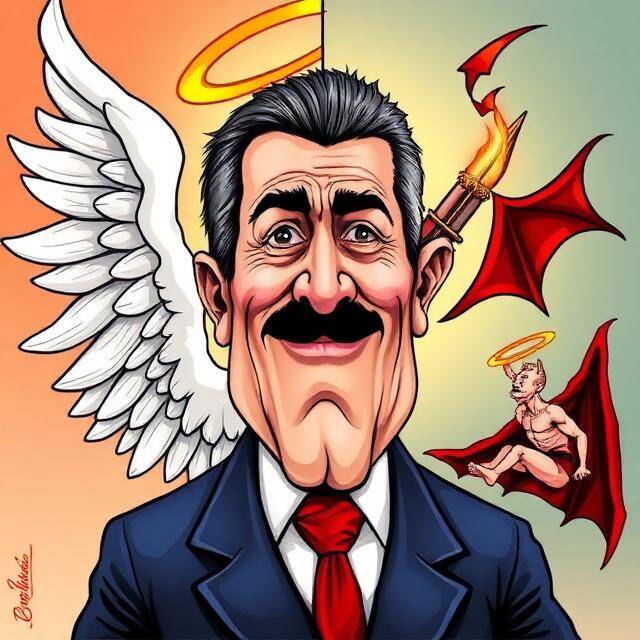
Just one day after a brutal, extrajudicial attack on Venezuela, the kidnapping of a sitting sovereign president, and an imperial demand that the country surrender its natural resources, the approved discourse insists on a single, dishonest choice: either Nicolás Maduro is a diabolical tyrant who deserved it—or a flawless anti-imperialist hero who must never be questioned.
That framing is a lie.
There is nothing—nothing—that can justify the illegal seizure, destabilization, or destruction of a sovereign nation by a mafia-state led by a convicted grifter like Donald Trump.
Sanctions are collective punishment.
Regime change is colonialism with better branding.
Period.
https://www.cepr.net/publications/sanctions-venezuela
But rejecting imperial barbarism does not require laundering authoritarian decay. And this is where the right—and too much of the left—both fail.
The truth is not “Maduro the demon” nor “Maduro the martyr.”
He is neither diablo ni santo—he is a mezcolanza that curdled into something else.
Oil, Class, and the Bolivarian Break
Venezuela possesses the largest proven oil reserves on Earth, a reality that has structured a century of extraction, inequality, and foreign interference
https://www.eia.gov/international/analysis/country/VEN
For decades, that wealth enriched foreign capital and domestic elites while the working class was treated as expendable. This was the historical rupture that produced Hugo Chávez and the Bolivarian project—an imperfect but real attempt at redistribution, popular participation, and sovereignty
https://nacla.org/article/hugo-chavez-and-bolivarian-process
That project mattered. Which is why it is worth defending from empire—and also worth defending from betrayal.
Maduro’s Rise: Inherited Power, Borrowed Legitimacy
Nicolás Maduro was shaped less by theory than by ideology and circumstance. In 1986, he traveled to Cuba for a year of political instruction—his only formal education beyond high school
https://apnews.com/article/venezuela-maduro-president-bus-driver-cuba-5d7d98f6e4f44c6a9b9e58c71d8c1a5a
He later worked as a Caracas metro bus driver, rising quickly as a union leader. By the 1990s, Venezuelan intelligence already described him as a radical leftist with close ties to Cuba
https://www.dallasnews.com/news/world/2026/01/03/how-venezuelas-maduro-rose-from-bus-driver-to-president-and-landed-in-us-custody/
After Chávez’s 1994 pardon, Maduro joined the Bolivarian movement and climbed the ranks: legislator, National Assembly president, six years as foreign minister, then vice president
https://apnews.com/article/venezuela-election-maduro-chavez-successor-2013-6a4e4f8b3c7d4c2c9c5f1e6c7b9a0a1
In his final address, Chávez personally anointed Maduro as successor
https://www.bbc.com/news/world-latin-america-20664349
Maduro’s 2013 victory was narrow and rested almost entirely on Chávez’s residual popularity
https://www.reuters.com/world/americas/maduro-wins-venezuela-election-narrow-margin-2013-04-15/
Continuity That Bought Time—but Not Trust
Maduro did not immediately abandon Chavismo. His government expanded CLAP food programs during peak shortages
https://venezuelanalysis.com/analysis/14531
It pushed forward Gran Misión Vivienda Venezuela, claiming over 4.6 million homes delivered by 2023
https://en.wikipedia.org/wiki/Gran_Misi%C3%B3n_Vivienda_Venezuela
These programs kept millions afloat and explain why much of the Global South rejected U.S. sanctions and coup efforts
https://www.cepr.net/sanctions-against-venezuela-are-devastating-and-illegal/
But social programs cannot substitute indefinitely for democracy, accountability, and popular power.
From Popular Project to Bonapartist Rule
By the mid-2010s, the rupture came—not from the right, but from the left.
Left analysts describe Maduro’s government as bonapartist: a regime that concentrates power in a civil-military elite ruling in the name of the people while neutralizing them politically
https://leftvoice.org/venezuela-maduros-bonapartist-regime-and-the-left/
Communes were sidelined. Worker control evaporated. Loyalty replaced participation
https://venezuelanalysis.com/analysis/14958
Repressing the Left: The Unforgivable Sin
Maduro did not merely repress the right. He repressed the left.
The Communist Party of Venezuela (PCV) broke with the government and joined the Popular Revolutionary Alternative (APR)
https://en.wikipedia.org/wiki/Popular_Revolutionary_Alternative
PCV General Secretary Óscar Figuera stated:
“They talk about socialism, revolution, Bolivarianism—while trampling on and massacring the rights of the people.”
https://idcommunism.com/2021/01/communist-party-venezuela-breaks-maduro.html
This is not State Department propaganda.
This is leftist revolt from within.
Petro’s Line in the Sand: When Even the Left Says “No”
The democratic crisis grew so severe that even sympathetic left governments refused to pretend.
Colombian President Gustavo Petro, speaking to CBS News, said plainly:
“Venezuela has not had free elections.”
https://www.cbsnews.com/news/colombia-president-gustavo-petro-venezuela-elections-not-free/
Petro was explicit that recent Venezuelan elections were not free and not fair, because:
“The conditions did not allow a truly open electoral contest.”
https://latinamericareports.com/petro-says-venezuela-elections-not-free/
He added that recognizing such elections would undermine democracy itself, and called instead for renewed dialogue under genuinely democratic conditions
https://www.cbsnews.com/news/gustavo-petro-interview-cbs-face-the-nation/
When the left refuses recognition, the problem is not optics—it is legitimacy.
The $200 Million Question That Ends the Debate
Here is the question no revolutionary rhetoric can survive:
Would a real socialist demand $200 million and legal amnesty to walk away from power?
Because that is exactly what Nicolás Maduro is alleged to have done.
According to reporting summarized by Colombia One, Maduro told Donald Trump he would step down if he could keep roughly $200 million and receive blanket legal immunity
https://colombiaone.com/2025/11/venezuela-maduro-trump-call-exile/
Reuters independently confirmed talks about stepping down in exchange for amnesty and sanctions relief, even if it did not specify the exact amount
https://www.reuters.com/world/americas/maduro-open-step-down-amnesty-talks-2025-11-22/
Pause.
A socialist does not negotiate exile like a fugitive oligarch.
A revolutionary does not price himself like a hedge-fund exit.
A leader committed to the people does not say: “I’ll give you the country—just let me keep the money.”
That is not resistance.
That is Judas economics.
The Contrast That Tells You Everything: Pepe Mujica
If you want to know what a president concerned for his people looks like, look south.
José Mujica, former president of Uruguay, lived on a small farm, donated most of his salary, and famously drove a beat-up Volkswagen Beetle while in office
https://www.bbc.com/news/magazine-20243493
Mujica once said:
“I’m not poor. Poor are those who want more.”
https://www.theguardian.com/world/2013/nov/15/jose-mujica-uruguay-poorest-president
No offshore accounts.
No exile bargaining.
No $200 million escape hatch.
That is what leadership without greed looks like.
That is what socialism without quotation marks looks like.
The Only Coherent Left Position
Imperial kidnapping? Criminal.
Sanctions? Economic warfare.
Trump’s “concern”? A joke written in blood.
But Maduro is not the revolution.
He monetized it.
Venezuela deserves sovereignty and democracy.
The people deserve justice—not empire, not oligarchs in red jackets.
Let Maduro face the will of the Venezuelan people, not the oligarchic fury of Washington—and not the historical eraser of blind solidarity.
That is not centrism.
That is leftism without illusions.
Añadir comentario
Comentarios