

It is no secret: much of the world speaks two or three languages. Speaking more than one language opens doors—to community, commerce, education, culture and human understanding. In 2026, selling monolingualism as a virtue is not defending the future; it is romanticizing backwardness. But that is exactly what a group of Idaho lawmakers wants to do: turn their cultural narrow-mindedness into a constitutional mandate and force the state to march backward while the rest of the world moves ahead.
HJR 6 is no longer just a legislative stunt or a symbolic proposal gathering dust in some corner of the Statehouse. The Legislature approved it in 2025 by more than the required two-thirds margins: 59–8 in the House and 30–5 in the Senate. Now Idaho voters will decide on November 3, 2026, whether to write this proposal into the state Constitution. It needs only a simple majority of the votes cast on the measure.
And one point needs to be made clear from the beginning: Idaho already has an official language. English has been designated the state’s official language under Idaho Code § 73-121 since 2007. HJR 6 therefore does not fill a gap in the law. It does something far more consequential: it attempts to place a more rigid, more sweeping formula—with far fewer explicit exceptions than current law—into the state Constitution.
They are not saving English. English is not in danger. They are building a tool to restrict when, how and for whom government may communicate.
What Voters Will See on the Ballot
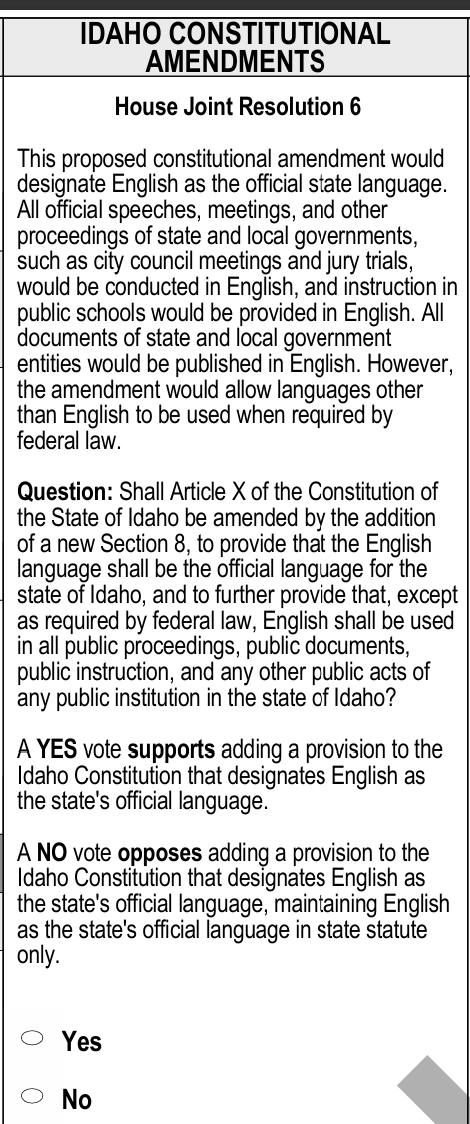
The ballot explanation and question state:
This proposed constitutional amendment would designate English as the official language of the state. All official speeches, meetings and other proceedings of state and local governments, such as city council meetings and jury trials, would be conducted in English, and instruction in public schools would be provided in English. All documents issued by state and local governmental entities would be published in English. However, the amendment would allow other languages to be used when required by federal law.
Question: Shall Article X of the Constitution of the State of Idaho be amended by adding a new Section 8 to provide that the English language shall be the official language of the State of Idaho and to further provide that, except as required by federal law, English shall be used in all public proceedings, public documents, public instruction and any other public act of every public institution in the State of Idaho?
A YES vote supports adding a provision to the Idaho Constitution designating English as the state’s official language.
A NO vote opposes adding such a provision to the Idaho Constitution, leaving English designated as the official language only under existing state law.
○ Yes
○ No
Supporters argue in the voter pamphlet that the amendment could encourage people who are not proficient in English to learn it, promote unity, reinforce a common identity and reduce government spending. They add that critical language services would remain available whenever federal law requires them.
It sounds harmless when written that way. The problem lies in what the proposed constitutional amendment leaves out.
Existing law does more than declare English the official language. It also expressly permits the use of other languages for law enforcement, public health and safety needs; in schools under education rules; in public colleges and universities; for tourism and economic development; and in libraries, among other exceptions. HJR 6 does not carry those protections forward. Its only explicit escape valve is: “except as required by federal law.”
That difference is not cosmetic. A future Legislature can amend a state statute. A constitutional provision governs public institutions, shapes future legislation and could ultimately land before judges forced to decide what “public instruction,” “public document” or “any other public act” actually means.
The Architects of This Backward Step
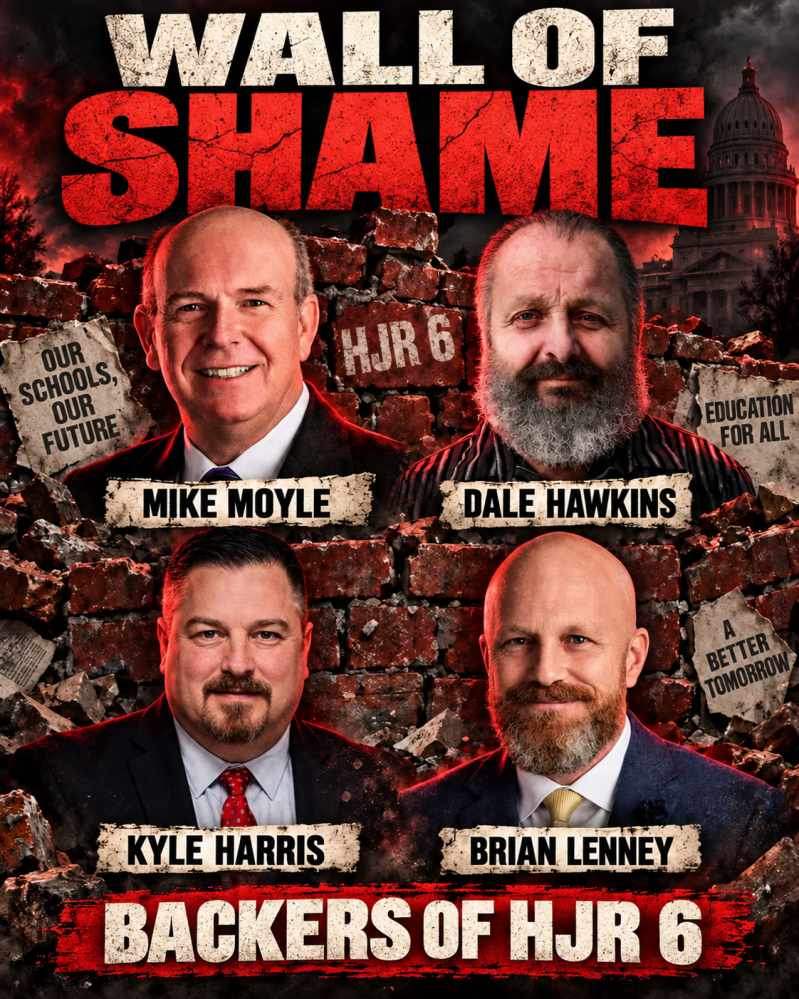
Four Republicans sponsored the measure:
-
House Speaker Mike Moyle of Star.
-
Rep. Dale Hawkins of Fernwood, HJR 6’s House floor sponsor.
-
Rep. Kyle Harris of Lewiston.
-
Sen. Brian Lenney of Nampa, HJR 6’s Senate floor sponsor.
These are not four gentlemen who suddenly lost sleep over English grammar. They are also figures who have promoted or supported much of the Idaho Legislature’s anti-immigrant offensive.
Dale Hawkins sponsored HB 659, HB 660, HB 700 and HB 764; carried HB 659 and HB 660 on the House floor; supported SB 1441; and participated in replacing an E-Verify proposal with another mandate for cooperation with ICE. Kyle Harris sponsored HB 659, HB 660 and HB 700; presented HB 700 on the House floor; and supported E-Verify legislation. Mike Moyle supported SB 1441 and voted for HB 659, HB 660, HB 700, HB 704 and the amended version of SB 1247. Brian Lenney helped publicly lead the package, sponsored SB 1318, voted for SB 1247 and SB 1442, and presented HJM 20 in the Senate.
Those proposals included mandatory agreements between local law enforcement and ICE, the collection of immigration-related data in arrests and schools, employment restrictions and E-Verify, refugee-related audits, school funding provisions, and penalties against organizations accused of helping undocumented people. Some were changed, some died and others advanced. What matters is the pattern. This was not a single public-policy proposal; it was a strategy for inserting immigration status into schools, jobs, policing and everyday public services.
Hawkins and Lenney participated in the public rollout of that package in February 2026, with Kyle Harris among the lawmakers in attendance. Supporters acknowledged working with Theo Wold, a former official in Donald Trump’s first White House, former Idaho deputy attorney general, senior Palantir adviser and visiting fellow at the Heritage Foundation.
Brian Lenney left little room for doubt about the ideology behind the effort. He tied immigration to an alleged “demographic replacement” carried out through refugees, human trafficking and cheap labor. In another statement, he said Idaho had to end the “plundering” of the state by foreigners, both legal and undocumented. When a lawmaker places legal immigrants and undocumented immigrants under the same accusation of plunder, immigration status is no longer the real issue. To him, the problem is the foreigner.
That is why HJR 6 cannot be examined in isolation. The same political current that wants to turn local police into ICE auxiliaries, track the nationality of people who are arrested, scrutinize students’ immigration status and discipline employers now wants to decide which languages a public institution may use. These are different pieces of the same political architecture: marking who belongs, who must justify their presence and who deserves to be heard.
Trump’s Fingerprints
HJR 6 appeared six days after Donald Trump signed Executive Order 14224, declaring English the official language of the federal government. Dale Hawkins admitted the connection plainly, saying he had taken “a page out of the Trump administration’s playbook.”
That was not a stylistic coincidence. In July 2025, Trump’s Justice Department issued guidance implementing the order, rescinded Executive Order 13166 on language access and portrayed earlier translation policies as wasteful and ideologically driven. Obligations created directly by federal statutes and court decisions did not magically disappear. But the federal shift demonstrates why the phrase “when required by federal law” is not a generous safeguard. It is a floor that a hostile administration can attempt to lower through new regulations, interpretations and litigation.
HJR 6 would follow the same logic in Idaho: provide only what the government cannot legally deny—and nothing more. Not out of good judgment. Not out of basic humanity. Not even when a translation could save a life.
ProEnglish: The History Its Supporters Would Rather Not Discuss
The amendment is also supported by ProEnglish. So far, there is no public evidence of direct coordination between the organization and HJR 6’s four sponsors; claiming otherwise would go beyond the evidence. What is documented is that ProEnglish has followed Idaho’s official-English campaign since the state law passed in 2007, celebrated its progress over the years and, in August 2026, promised to do everything in its power to raise awareness and secure HJR 6’s passage.
ProEnglish describes itself as the nation’s leading organization dedicated to establishing English as the official language. It also openly states that it wants to end bilingual education and replace it with English-immersion programs. Its interest in HJR 6 is therefore not a malicious interpretation invented by opponents; it is entirely consistent with the organization’s own published mission.
But to understand ProEnglish, you have to follow the family tree.
The organization was founded in 1994 under its original name, English Language Advocates, by John Tanton and members of his network. Years earlier, Tanton had resigned as chairman of U.S. English after the disclosure of memos that Linda Chavez—then the organization’s president and a former Reagan administration official—called anti-Hispanic and anti-Catholic. Walter Cronkite also cut ties with the organization after the controversy.
Tanton founded, co-founded, promoted or financed a network that included the Federation for American Immigration Reform, better known as FAIR; the Center for Immigration Studies; NumbersUSA; U.S. English; Social Contract Press; and other organizations devoted to restricting immigration. His documents and activities revealed a persistent concern with preserving a European-American demographic majority, along with ties to eugenic ideas.
His publishing house, Social Contract Press, released an English edition of The Camp of the Saints, a racist, apocalyptic French novel about nonwhite refugees overrunning Europe. The book later became a cult text for figures such as Steve Bannon. In 2012, ProEnglish organized a CPAC panel called “The Failure of Multiculturalism,” featuring Peter Brimelow, founder of VDARE.
VDARE, incidentally, published a personal attack against me in 2009 for having gone—from its sneering point of view—from a conservative radio host to a “defensor de la raza,” or defender of the Latino community. I mention it because this network is not an academic abstraction to me. I know its contempt, its language and its habit of treating Latino civic participation as a threat.
Not everyone who supports making English official shares every one of Tanton’s ideas, and we do not need to commit that fallacy to recognize the problem. The relevant fact is this: the national movement behind these measures did not emerge from some innocent, patriotic vacuum. It developed within a network that spent decades portraying Latino growth, immigration and multiculturalism as demographic and cultural threats.
The Opposition—and the Absurdity of Paying to Duplicate What Already Exists
Those opposing HJR 6 include Democratic Sen. Melissa Wintrow and Democratic Reps. Steve Berch and John Gannon.
Wintrow pointed out the obvious: Idaho already recognizes English as its official language. Even so, the state estimated that placing and explaining the amendment on the ballot could cost roughly $300,000 if those costs were not already triggered by other ballot measures. She also raised concerns about court interpretation services.
Gannon objected in particular to the phrase “public instruction.” His concern goes to the heart of the matter: students who are still learning English need support in a language they understand so they can meaningfully access academic content while developing English proficiency. Federal law requires schools to take affirmative steps to overcome language barriers, but it does not automatically require every dual-language immersion program, every academic course taught partly in Spanish or every language-preservation project.
The official argument against the amendment likewise warns that current law is more detailed and protects uses that HJR 6 does not mention, including foreign-language instruction. It also cautions that the measure could divide society by telling people who do not speak English that they are unwelcome in Idaho—or even in their own communities.
That is the political con: spend public money to put something into the Constitution that state law already provides, but do it with fewer exceptions, more ambiguity and greater potential for conflict. Then call it “efficiency.”
What Could Happen in a Worst-Case Scenario?
HJR 6 does not explicitly order Idaho to shut down dual-language schools tomorrow, eliminate every interpreter or remove every Spanish-language brochure. However, the amendment’s wording would invite challenges, administrative cutbacks and litigation precisely because it replaces a broad list of state exceptions with a single minimum exception: whatever federal law requires.
In a reasonable worst-case scenario, these are some of the areas that could be at risk:
Dual-Language Immersion Schools
Spanish-English programs could be challenged, reduced or defunded when teaching academic subjects in Spanish is not strictly necessary to meet a federal obligation. Even the official argument against HJR 6 acknowledges that the words “public instruction” could reach foreign-language education.
Communication With Parents and Families
Newsletters, meetings, report cards, school portals and emergency messages in Spanish could be limited to whatever minimum some authority decides federal law requires. A family should not need an attorney to determine whether it has the right to understand what is happening with its child.
Emergency Alerts
Current law expressly permits other languages for public health and safety. HJR 6 contains no such exception. Spanish-language warnings about wildfires, evacuations, contaminated water, disease outbreaks or natural disasters could be attacked as public acts not specifically mandated by federal law. A court might ultimately protect them. The absurdity is forcing Idahoans to fight over the question after the Constitution has already been changed.
Police, Courts and Administrative Hearings
The right to interpretation would continue in circumstances protected by the Constitution or federal law, especially when due process and criminal defense are at stake. But voluntary police outreach, certain civil proceedings, administrative hearings and language services that exceed the federal minimum would become more vulnerable to cuts.
Health Care and Social Services
Title VI of the Civil Rights Act would continue to prohibit national-origin discrimination in programs receiving federal assistance. Even so, the scope of federal language-access guidance has become less certain under Trump. Programs funded solely by the state might provide only what an attorney concludes is strictly mandatory.
Elections
Election materials required by Section 203 of the Voting Rights Act would remain protected in covered jurisdictions. But voluntary Spanish-language guides, voter-education campaigns and supplemental materials could disappear when no specific federal mandate exists.
Libraries
Current law expressly protects certain uses of other languages in libraries. HJR 6 does not. Collections, activities, cultural programs and assistance in other languages could become targets of complaints or lawsuits alleging that they constitute “public acts.”
Public Colleges and Universities
Language courses, subjects taught in another language, international programs and academic projects could become litigation targets. That may sound like an extreme interpretation, but the amendment uses the absolute phrase “all public instruction” without carrying forward the higher-education exception found in current law.
The DMV and Local Governments
Manuals, forms, websites, public notices, meetings and Spanish-language guidance could disappear whenever an office decides federal law does not require them. A city might want to communicate with all its residents and still fear that doing so would violate the state Constitution.
Tourism, Commerce and Economic Development
Current law expressly allows other languages to promote tourism and economic development. HJR 6 is silent. It would be a distinctly Idaho kind of irony to prevent a public agency from attracting visitors or investment in Spanish, French, Japanese or Mandarin—all in the name of “efficiency.”
Indigenous Languages
Sovereign tribal governments would not be subject to the Idaho Constitution in the same way as state institutions. Even so, Indigenous-language programs operated jointly with public schools or state universities could face new questions, challenges or restrictions.
That is the point: even if some of these challenges eventually failed in court, HJR 6 would create the weapon, the incentive and the uncertainty. Institutions could cut services before a lawsuit is ever filed. Officials could censor themselves out of fear. Communities would then have to spend time and money fighting to recover what current law clearly permits.
This Is Personal, Too
Am I fighting HJR 6 out of personal interest? Of course I am—and I am not ashamed to say it.
I have worked in Spanish-language media since 1989. I am a founding member of the Hispanic Chamber. My wife teaches Spanish dual-language immersion. As a member of the Planning and Zoning Commission, I worry that this amendment could prevent me from hearing testimony directly in Spanish from a member of my own community unless some federal obligation happens to protect it.
But my opposition does not end with my job, my family or my public service. I am thinking about the farmworker who needs to understand an evacuation alert; the mother who needs to speak with her daughter’s teacher; the citizen who wants to understand the ballot; the defendant who needs to know what is happening in a courtroom; the patient who cannot describe pain in English; the student learning science while learning a new language; and the older adult who has paid taxes for decades but still expresses himself or herself more clearly in Spanish.
There is no unity when government forces part of the population to be silent so another part can feel culturally comfortable. That is not social cohesion. It is linguistic obedience.
English does not need a constitutional wall. It is spoken in the Legislature, the courts, the schools, businesses and virtually every institution of power in Idaho. Spanish, Indigenous languages and other languages do not threaten it. They complement it, extend the reach of government and allow more people to take part in public life.
What We Can Do
First, talk to a friend, relative, school board member, coworker or anyone else who can vote. Explain that Idaho already has English as its official language—and that HJR 6 strips away the detailed exceptions contained in current law.
Second, if you are a U.S. citizen and registered to vote, go to the polls on November 3, 2026, and vote NO on HJR 6.
Third: vote, vote, and keep reminding everyone else to vote. Constitutional amendments can survive for generations. One afternoon of apathy can become decades of restriction.
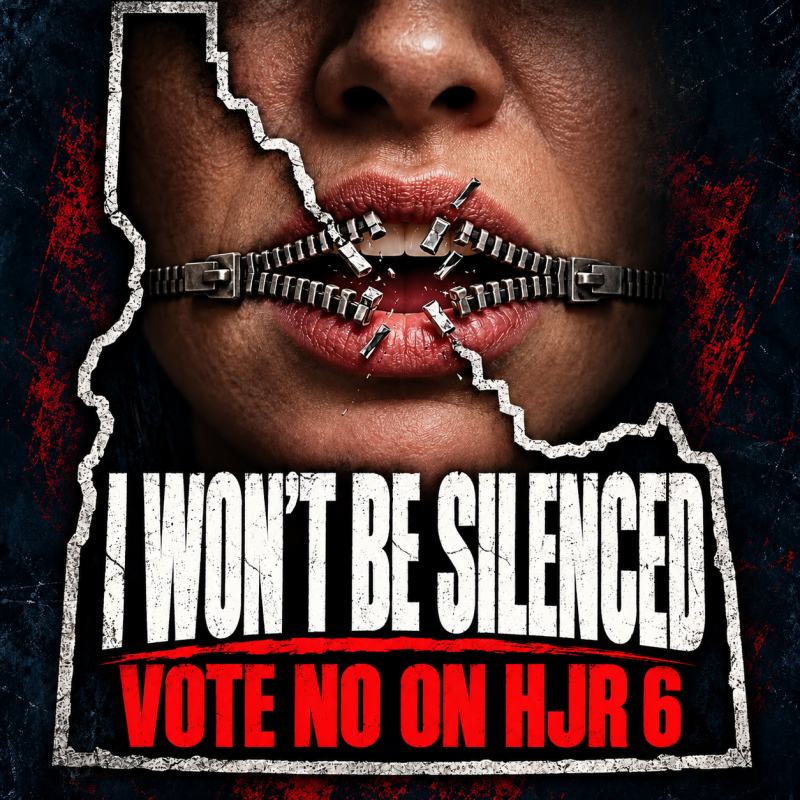
Between now and Election Day, use the I WON’T BE SILENCED emblem as your profile picture. Let them know that our language is not a source of shame, our participation does not require anyone’s permission and we will not allow four politicians to write their cultural hang-ups into everyone’s Constitution.
On November 3, vote NO on HJR 6.
Because we learned English without forgetting Spanish. Because belonging does not require disappearing. And because when politicians confuse unity with silence, our answer must be loud and clear:
I WON’T BE SILENCED.
#ElChupacast
Sources and Documentation
HJR 6: Text, Votes and Ballot Arguments
-
Vote Idaho, “Initiatives & Amendments”: https://voteidaho.gov/initiatives-amendments/
-
Ballotpedia, “Idaho HJR 6, English as Official State Language Amendment (2026)”: https://ballotpedia.org/Idaho_HJR_6%2C_English_as_Official_State_Language_Amendment_%282026%29
-
Idaho Capital Sun, “English could become Idaho's official language, under constitutional amendment” (March 25, 2025): https://idahocapitalsun.com/2025/03/25/english-could-become-idahos-official-language-under-constitutional-amendment/
-
Idaho Capital Sun, “Idaho legislators approve language for ballot measures on marijuana, English as official language” (June 4, 2026): https://idahocapitalsun.com/2026/06/04/idaho-legislators-approve-language-for-ballot-measures-on-marijuana-english-as-official-language/
-
Idaho Code § 73-121, current statutory language: https://law.justia.com/codes/idaho/title-73/chapter-1/section-73-121/
Immigration Legislation and Statements From Its Supporters
-
Idaho Capital Sun, “Idaho lawmakers announce slate of immigration bills, crafted with influential think tank” (February 9, 2026): https://idahocapitalsun.com/2026/02/09/idaho-lawmakers-announce-slate-of-immigration-bills-crafted-with-influential-think-tank/
-
Idaho Education News, “New bill would track immigration status of Idaho students” (February 11, 2026): https://www.idahoednews.org/top-news/statehouse-roundup-2-11-26-new-bill-would-track-immigration-status-of-idaho-students/
-
Idaho Capital Sun, “Idaho Legislature to consider spectrum of E-Verify bills this session” (February 25, 2026): https://idahocapitalsun.com/2026/02/25/idaho-legislature-to-consider-spectrum-of-e-verify-bills-this-session/
-
Idaho Capital Sun, “Bill to require all local law enforcement to apply for ICE agreements is sent to Idaho House” (February 26, 2026): https://idahocapitalsun.com/2026/02/26/bill-to-require-all-local-law-enforcement-to-apply-for-ice-agreements-is-sent-to-idaho-house/
-
ACLU of Idaho, 2026 immigration legislation index: https://www.acluidaho.org/legislation/?issue=immigrant-refugee-rights&legislative-session=2026&page=1
-
ACLU of Idaho, HB 700: https://www.acluidaho.org/legislation/2026-hb-700-misdemeanor-for-employing-unauthorized-workers/
-
ACLU of Idaho, HB 704: https://www.acluidaho.org/legislation/2026-hb-704-expanded-restrictions-for-unauthorized-workers/
-
ACLU of Idaho, SB 1247: https://www.acluidaho.org/legislation/2026-sb-1247-idaho-e-verify-act/
-
ACLU of Idaho, SB 1441: https://www.acluidaho.org/legislation/2026-sb-1441-statewide-ice-partnership/
-
LegiScan, HB 659 votes: https://legiscan.com/ID/votes/H0659/2026
-
LegiScan, HB 700 votes: https://legiscan.com/ID/votes/H0700/2026
-
LegiScan, SB 1247 text: https://legiscan.com/ID/text/S1247/id/3342710/Idaho-2026-S1247-Introduced.pdf
-
LegiScan, HJM 20: https://legiscan.com/ID/bill/HJM020/2026
Trump and Official English
-
GovInfo, Executive Order 14224, “Designating English as the Official Language of the United States” (March 1, 2025): https://www.govinfo.gov/app/details/DCPD-202500315
-
U.S. Department of Justice, guidance implementing Trump’s order (July 14, 2025): https://www.justice.gov/opa/pr/justice-department-releases-guidance-implementing-president-trumps-executive-order
-
U.S. Department of Justice, limited English proficiency page and suspension of earlier guidance: https://www.justice.gov/crt/limited-english-proficiency
ProEnglish and the John Tanton Network
-
ProEnglish, “The State of Official English Report — Summer 2026”: https://proenglish.org/2026/08/25/the-state-of-official-english-report-summer-2026/
-
ProEnglish, “Official English on November Ballot in Idaho”: https://proenglish.org/2026/07/01/official-english-on-november-ballot-in-idaho/
-
ProEnglish, Idaho and the 2007 law: https://proenglish.org/idaho/
-
ProEnglish, position opposing bilingual education: https://proenglish.org/bilingual-education/
-
ProEnglish, “About Us”: https://proenglish.org/about-us/
-
Education Week, Linda Chavez’s resignation over the Tanton memo (1988): https://www.edweek.org/education/chavez-quits-u-s-english-over-repugnant-memo/1988/10
-
Los Angeles Times, background on Tanton, FAIR and the memo: https://www.latimes.com/archives/la-xpm-1993-11-24-mn-60272-story.html
-
Southern Poverty Law Center, profile of John Tanton: https://www.splcenter.org/resources/extremist-files/john-tanton/
-
Southern Poverty Law Center, profile of Social Contract Press: https://www.splcenter.org/resources/extremist-files/social-contract-press/
-
CBS News, ProEnglish panel with Peter Brimelow at CPAC: https://www.cbsnews.com/news/immigration-speaker-sparks-controversy-at-cpac/
-
VDARE, 2009 attack on Ben Reed: https://vdare.com/articles/memo-from-middle-america-formerly-known-as-memo-from-mexico-from-conservative-radio-shock-jock-to-defensor-de-la-raza-the-ben-reed-story
Añadir comentario
Comentarios